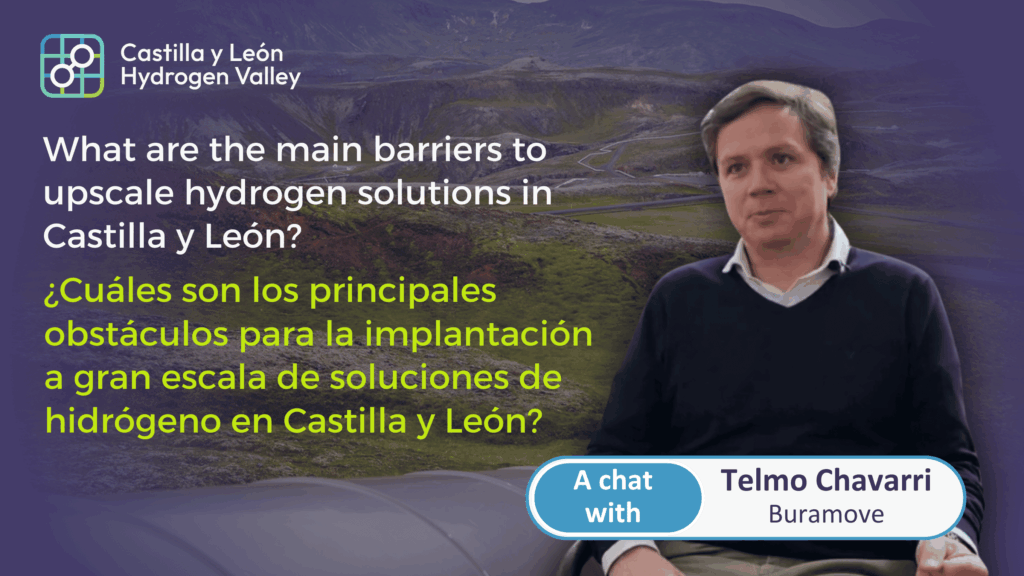
The Castilla y León Hydrogen Valley is sharing a new video interview, and this time the spotlight falls on one of the industrial partners turning the vision into on-the-ground infrastructure: Telmo Chavarri, COO of BURAMOVE. In a candid conversation, he explains his company’s role in the valley and the barriers and opportunities involved in building a green hydrogen economy from the ground up.
BURAMOVE is behind a green ammonia production project for the chemical industry in Burgos. Within the valley, the company is building the production plant and will operate it during its first years, taking care of the distribution and commercialisation of the hydrogen. It is also laying a 3 km pipeline to carry clean hydrogen from the plant to a refuelling station within the same industrial estate.
Scaling hydrogen in the region, however, is not without obstacles. Chavarri highlights two main barriers. The first is regulatory: as a new market, green hydrogen has to find its place within rules and permitting procedures designed for more conventional technologies, and the project has to move step by step to adapt them. The second is economic:
“There is a gap between the price of green hydrogen and its conventional alternative, whether in mobility or in chemical products. We need to work closely with local, regional and state authorities so that, through effective subsidies or tax credits, they help both hydrogen producers and consumers to close that gap — so the solutions are competitive and industry keeps its competitiveness while decarbonising”
Despite these challenges, Chavarri is convinced of the value of green hydrogen, especially where other clean options fall short:
“Green hydrogen is a magnificent tool to decarbonise industrial sectors that are hard to decarbonise, where electrification is not an economical alternative. By decarbonising these industries, we make them sustainable in the long term — and with that come quality jobs that are sustainable over time, and in the region.”
For Chavarri, decarbonising these hard-to-abate sectors is also about the region’s future: keeping local industry competitive and sustaining quality, long-term jobs. With a five-year challenge ahead to bring the valley to life, BURAMOVE’s work on production and supply is a concrete step in that direction.